How to Draw a Circle on a Map for Farm Planning
How to Draw a Circle on a Map for Farm Planning Quick answer: To draw a circle on a map, open a map tool, click the center point, and type the ...
GPS Field Area Measure Editorial
Field GIS Specialist · 10 min read
How to Draw a Circle on a Map for Farm Planning
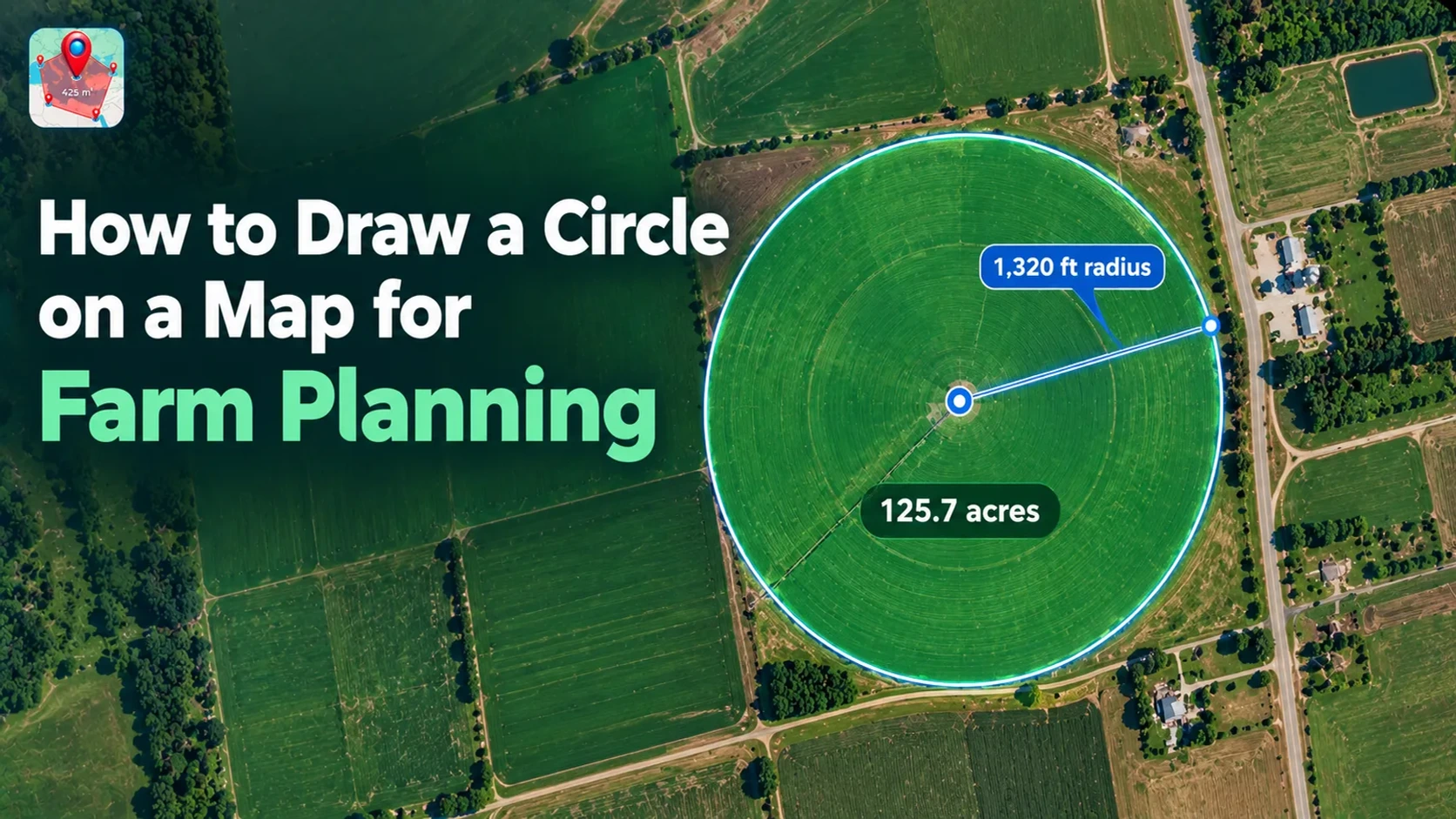
Quick answer: To draw a circle on a map, open a map tool, click the center point, and type the radius (the distance from the center to the edge). The circle appears on your satellite map with its area in acres. A circle with a radius of 1,320 feet (a quarter mile) covers about 125.7 acres.
Farmers use circles for many jobs. A round watering system (a center pivot) waters a circle. A safe gap around a stream or well is a circle. The reach of a pipe or a hose is a circle too. When you draw a circle on a map, you see at once how much land it covers and what it misses. This guide shows you how, with simple steps, real numbers and a chart you can use today.
Why farmers draw circles on maps
A circle is the shape of anything that reaches out the same distance in every direction. That is why it fits so many farm jobs:
- Round watering systems: a center pivot turns around one fixed point and waters a circle.
- Spray safety gaps: a set distance from a house, a stream or a road. Always follow the product label and local rules for the exact distance.
- Reach from a water source: how far a pipe or hose can go from a well or tank.
- Field zones: the land within a set distance of a barn, a gate or a storage shed.
A drawn circle turns a guess into a picture, and it shows the acres inside.
So what does the circle actually show? That comes down to one number, the radius.
What is a radius?
The radius is the distance from the center of a circle to its edge. That is the only number you need to draw a circle.
- The diameter is the distance all the way across. It is always twice the radius.
- The center is the fixed spot in the middle. For a center pivot, it is the pivot point where the system stands.
Example: If your watering system stretches 1,000 feet from the center to the last wheel, your radius is 1,000 feet, and your diameter is 2,000 feet.
With the radius known, you can work out how much land the circle covers.
How many acres are in a circle?
Use this rule:
Area = π × radius × radius
Pi (π) is about 3.14. This gives square feet. Divide by 43,560 to get acres, because 1 acre is 43,560 square feet.
Worked example (a quarter-mile radius):
- A quarter mile is 1,320 feet, so the radius is 1,320.
- 1,320 × 1,320 = 1,742,400.
- 1,742,400 × 3.14159 = about 5,473,900 square feet.
- 5,473,900 ÷ 43,560 = about 125.7 acres.
You do not have to do this by hand. Use the chart below, or let the tool do it.
Radius-to-acres chart
| Radius (feet) | Area in acres | Area in hectares | Distance around the edge |
|---|---|---|---|
| 300 | 6.5 | 2.6 | 0.36 mile |
| 500 | 18.0 | 7.3 | 0.59 mile |
| 800 | 46.2 | 18.7 | 0.95 mile |
| 1,000 | 72.1 | 29.2 | 1.19 miles |
| 1,320 (quarter mile) | 125.7 | 50.9 | 1.57 miles |
Working in metres? A circle with a radius of 400 metres covers about 50.3 hectares, or about 124.2 acres.
Now let's use this for the most common farm case, a round watering system.
How to plan a center pivot with a circle
A center pivot is a long watering arm that turns around a fixed center point. It waters a perfect circle. Drawing that circle on a map before you buy or place one shows you three things.
1. How many acres it will water
Your radius decides your acres. The chart above shows how fast the area grows. Going from 1,000 feet to 1,320 feet adds more than 50 acres.
2. How much land is left over
A circle never fills a square field. Take a standard square of land, the "quarter section," which is 160 acres and measures 2,640 feet on each side. The biggest circle that fits inside it has a radius of 1,320 feet. That circle waters about 125.7 acres, so about 34 acres in the corners stay dry. In other words, a circle uses about 78.5% of the square it sits in.
Those corners are not lost. Many farmers plant them with dryland crops, use them for buildings, or leave them for wildlife.
3. How much water you will need
Here is a simple rule: 1 inch of water on 1 acre is about 27,154 gallons.
Worked example: To put 1 inch of water on a pivot that covers 125.7 acres:
- 125.7 × 27,154 = about 3.4 million gallons.
That number helps you plan your pump, your well and your water costs. To go deeper, try our Irrigation Runtime calculator.
Circles help with more than water. Here are a few other farm uses.
Other ways to use a circle on a farm
Spray safety gaps
Draw a circle around a stream, a well, a house or a school. The circle shows the area where you should not spray, or where you need extra care. The exact distance depends on the product label and your local rules, so read the label before you draw.
Water source reach
Put the center on your well or tank. Set the radius to the length of your pipe or hose. The circle shows which fields you can reach.
Travel and service zones
Put the center on your barn or shop. Set the radius to a distance you can cover in a set time. You will see which fields are close and which are far.
Test spots and field plans
Put the center on a spot you want to study, like a wet patch. A circle around it shows how much land the problem might affect.
Now let's draw one.
How to draw a circle on a map in 6 easy steps
- Open the tool. Go to our Radius and Pivot Circle tool. You do not need to sign up.
- Switch to satellite view. You will see your real fields, fences and buildings.
- Find your center point. Zoom in on the spot the circle should be built around, like your pivot point or your well.
- Click the center. This is where the circle starts.
- Type the radius. Enter your number and pick your unit, such as feet, metres or miles. The circle appears right away.
- Read the area and adjust. The tool shows the acres inside the circle. Change the radius until the circle fits your field, then save it.
Don't know your radius? Measure it. Use our Distance Ruler to click from the center to the far edge. Our guide on how to measure distance on a satellite map shows you how.
Even a simple tool can give a wrong answer if you make a small mistake. Here are the common ones.
Common mistakes and how to avoid them
| Mistake | Why it hurts | Simple fix |
|---|---|---|
| Using the diameter as the radius | Your circle is twice as wide, and the acres are four times too big | The radius is only half the way across |
| Putting the center in the wrong place | The whole circle moves off your field | Zoom in and click the exact center |
| Mixing up units | Feet, metres and miles give very different circles | Check the unit before you read the acres |
| Forgetting the corners | You think your whole field is covered | Compare the circle to your field shape |
| Trusting old photos | Fences and buildings may have changed | Check on the ground for big jobs |
| Ignoring the product label | Your safety gap may be too small | Follow the label and local rules |
If your field is not a circle, a circle alone will not tell you the total acres. Here is what to do next.
When a circle is not the right shape
A circle is perfect for round watering systems and for gaps around a point. It is the wrong shape for a field with uneven sides. For those, trace the outline instead. Our guide on how to measure acres of odd-shaped land shows you how.
A smart plan often uses both. Trace the field to get its true acres. Then draw a circle inside it to see how much a pivot could water, and how much land would be left over.
Once your circle is in the right place, you may want to share that exact spot with a helper, a dealer or a neighbour. Our next guide, how to read GPS coordinates, shows you how to write down and share any spot on a map.
Frequently asked questions
How do I draw a circle on a map?
Open a map tool and switch to satellite view. Click the center point, then type the radius and pick your unit. The circle appears on the map, and the tool shows how many acres are inside it.
How many acres are in a circle with a quarter-mile radius?
A circle with a radius of 1,320 feet, which is a quarter mile, covers about 125.7 acres. Multiply pi (3.14) by the radius times the radius, then divide by 43,560.
What is the difference between radius and diameter?
The radius is the distance from the center of a circle to its edge. The diameter is the distance all the way across. The diameter is always twice the radius.
How do I find the acres of a center pivot?
Measure the distance from the center point to the last wheel. That is your radius. Multiply pi by the radius times the radius, then divide by 43,560 to get acres. Or draw the circle on a map and read the area.
How much water is 1 inch on 1 acre?
One inch of water on one acre is about 27,154 gallons. For a pivot that covers 125.7 acres, 1 inch is about 3.4 million gallons.
Conclusion
To draw a circle on a map, click the center, type the radius and read the acres. The radius is the only number you need, and the chart above gives you the answer for the most common sizes. Use circles for watering systems, safety gaps and water reach, and trace your field when the shape is uneven. Open the Radius and Pivot Circle tool and plan your own farm today.
Read next: How to Read GPS Coordinates shows you how to share the exact spot of your circle with anyone.
Tags