How to Measure Acres of Odd-Shaped Land
To measure acres of odd-shaped land, draw its outline on a satellite map with an acreage calculator. Click each corner, close the shape and read the acres. No map tool? Split the land into triangles, add up their areas in square feet, and divide by 43,560.
GPS Field Area Measure Editorial
Field GIS Specialist · 8 min read
How to Measure Acres of Odd-Shaped Land
Written by [Author Name], [role] · Last updated: 29 September 2026 · 7 min read
Quick answer: To measure acres of odd-shaped land, draw its outline on a satellite map with an acreage calculator. Click each corner, close the shape and read the acres. No map tool? Split the land into triangles, add up their areas in square feet, and divide by 43,560.
Not every plot is a neat square. Fields bend around streams, roads cut corners and old fences follow paths nobody remembers. That makes it hard to know how much land you really have. This guide shows you three easy ways to measure acres of odd-shaped land. Land like this is often called "irregular," which just means it has uneven sides. You will also get a worked example and a unit chart you can use right away.
What is an acre?
An acre is a unit for measuring land. Here are the numbers worth knowing:
- 1 acre = 43,560 square feet
- 1 acre = about 4,047 square metres
- 1 acre is close to a square of 209 feet by 209 feet
A hectare is the other common unit. One hectare is 10,000 square metres, or about 2.47 acres.
Once you know what an acre is, here is why odd shapes are harder to measure.
Why odd-shaped land is hard to measure
For a square or a rectangle, you multiply length by width and you are done. Odd-shaped land has no single length or width. Its sides bend, slant and change direction. If you guess, your number can be far off.
The fix is simple: break the shape into easy parts, or let a map tool do it for you. Both ways work well. Here is how.
The old way uses simple math, so let's start there.
Method 1: Split the land into triangles
This method needs only a tape (or a distance tool) and a calculator. The idea is to cut your land into triangles, find each area and add them up.
The rule for one triangle is:
Area = ½ × base × height
The base is one side. The height is the straight-line distance from the base to the far corner, measured at a right angle.
How to do it:
- Sketch your plot on paper.
- Draw a line across it from one corner to the opposite corner. Choose a line that stays inside the plot. Now you have two triangles.
- Measure that shared line. It is the base for both triangles.
- For each triangle, measure the height from the base to the far corner.
- Work out each area, then add them together.
- Divide the total (in square feet) by 43,560 to get acres.
Worked example:
- The shared line (base) is 400 feet.
- Triangle A has a height of 250 feet: ½ × 400 × 250 = 50,000 square feet.
- Triangle B has a height of 180 feet: ½ × 400 × 180 = 36,000 square feet.
- Total = 86,000 square feet.
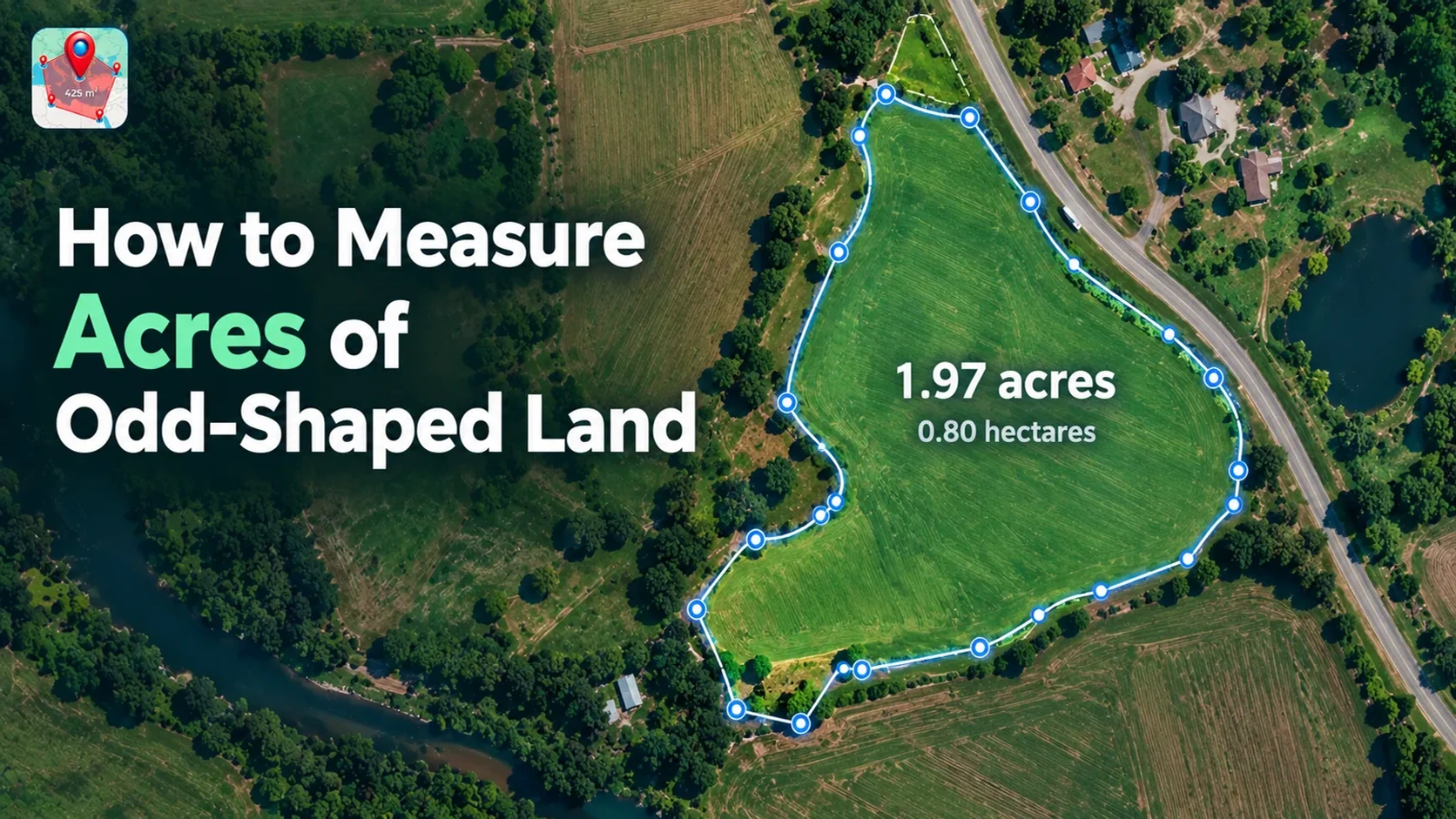
- 86,000 ÷ 43,560 = about 1.97 acres, or roughly 0.80 hectares.
For land with more corners, cut it into more triangles and add them all up. Need the lengths but do not want to walk? See our guide on how to measure distance on a satellite map.
The math works, but a map tool is much faster. Here is how to use one.
Method 2: Draw the boundary on a satellite map
This is the quickest way to measure acres of odd-shaped land. You trace the outline on a satellite photo, and the tool does the math.
- Open the tool. Go to our acreage calculator. You do not need to sign up.
- Switch to satellite view. You will see the real fences, trees and field edges.
- Zoom in on one corner. Closer zoom means a better answer.
- Click each corner. Go around the land, one corner after another. Add extra clicks on curves.
- Close the shape. Finish back at your first point.
- Read the result. The tool shows acres. Switch to hectares or square feet if you prefer.
Tips for a better answer:
- Use the clear edge you can see on the photo, like a fence line or crop edge.
- Click at every bend, not just the main corners.
- Save your measurement so you can open it later.
If you are standing on the land, you can also measure it on foot. Here is how.
Method 3: Walk the edge with your phone
You can also measure by walking the edge of your land with a phone that has GPS. Mark each corner as you reach it. The tool joins your marks into a shape and gives you the acres.
You can drop a mark at each corner with our Point Marker.
Keep in mind: most phones are accurate to about 5 metres (16 feet) in open sky, and worse near buildings and trees. On a large field, that small error hardly changes the answer. On a small plot, it can change the answer more. For small plots, Method 2 is often better.
No matter which way you measure, you may need to switch units. Here is a chart to help.
Quick unit chart
| Unit | In acres | In square feet | In square metres | In hectares |
|---|---|---|---|---|
| 1 acre | 1 | 43,560 | 4,047 | 0.4047 |
| 1 hectare | 2.471 | 107,639 | 10,000 | 1 |
| 1 square mile | 640 | 27,878,400 | 2,589,988 | 259 |
| 1 square kilometre | 247.1 | 10,763,910 | 1,000,000 | 100 |
A note on local units: units like the bigha change from place to place, and even from state to state. Check the local value before you convert.
Now you have the numbers. Before you use them, here is one important warning.
When you need a licensed surveyor
Every method above gives you a good estimate. That is perfect for planning, buying seed, estimating costs or getting a first idea of your land size. But an estimate is not a legal document.
Hire a licensed surveyor if you:
- Are buying or selling land
- Are settling a boundary dispute with a neighbour
- Are building near a boundary line
- Need papers for a loan, a tax form or a court
Once you know your acres, you can start planning how to use them. For example, a circle on the map can show how far a sprinkler reaches. Our next guide, how to draw a circle on a map for farm planning, shows you how.
Frequently asked questions
How do I measure acres of odd-shaped land?
Open an acreage calculator and switch to satellite view. Click each corner of your land, then close the shape. The tool shows the acres for you. Zoom in close and click at every bend for the best answer.
How many square feet are in an acre?
One acre is 43,560 square feet. To turn square feet into acres, divide by 43,560. For example, 86,000 square feet is about 1.97 acres.
How do I calculate acreage of irregular land without a tool?
Split the land into triangles. Find each area with half of the base times the height. Add the areas together, then divide the total in square feet by 43,560 to get acres.
Is a phone measurement good enough to sell or fence land?
It is good for planning and rough costs. It is not a legal measurement. For selling, buying, fencing on a boundary or settling a dispute, hire a licensed surveyor.
How many acres are in a hectare?
One hectare is about 2.471 acres. To turn hectares into acres, multiply by 2.471. To turn acres into hectares, multiply by 0.4047.
Conclusion
You can measure acres of odd-shaped land in three easy ways: split it into triangles, trace it on a satellite map, or walk the edge with your phone. The map tool is fastest for most people. Use the unit chart to switch between acres, hectares and square feet, and hire a surveyor for anything legal. Open the acreage calculator and measure your own land today.
Read next: How to Draw a Circle on a Map for Farm Planning shows you how to turn your acres into a smart farm plan.
Tags